

Kinsmen Debrief #2 – Learning from Ruslan KD on Godly Ambition
Today we’re continuing our Kinsmen Series, debriefing and re-presenting the learning that took place last week at the 2025 Kinsmen Summit. Each one of these sessions packed a different kind of punch, and my hope is that those reading today will not only enjoy the insights but also put a piece of it into practice in their daily lives.
Today we’re continuing our Kinsmen Series, debriefing and re-presenting the learning that took place last week at the 2025 Kinsmen Summit. Each one of these sessions packed a different kind of punch, and my hope is that those reading today will not only enjoy the insights but also put a piece of it into practice in their daily lives.
Ruslan KD is a Christian YouTuber with a massive following. His videos are viewed by millions, and nearly a million subscribers engage with his content for its pursuit of truth and his willingness to challenge us to be bold followers of Christ. His story is a powerful one. He is of Armenian descent and did not grow up as a follower of Christ. There were no churches where he came from, and it was only after coming to the U.S. that he found Jesus.
To learn more about Ruslan after reading this article, click here: https://www.youtube.com/@RuslanKD
His recent book, Godly Ambition, was the topic of his discussion at the Kinsmen Summit. My notes and takeaways are presented below.
Jesus Shows Us True Ambition and Purpose
Before we can explore what Jesus teaches, let’s pause and consider what most of us think of when we hear the word ambition. In modern U.S. culture, ambition often means climbing to the top in business, sports, media, or pursuing a legacy people will remember. Our perception has been shaped by what we’re advertised. What we see becomes what we desire, but the problem is that chasing what the world offers leads to an endless game of comparison—always leaving us empty, restless, and seeking something different. The world will always disappoint us this way.
So how did Jesus handle ambition?
Real ambition—real purpose—comes through serving. Serving others is the holiest form of ambition when it comes to how we spend our time and energy on earth. If you want to be great, serve. The greatest among you is the one who humbles himself and is willing to be the least. The last shall be first, and the first shall be last. This is truly the upside-down Kingdom.
“For whoever would gain their life will lose it, but whoever loses their life for me will save it.” – Luke 9:24
When it comes to ambition, accumulation is often its close cousin. Jesus warned against gaining the whole world while losing our soul. Too often our ambitions revolve around acquiring more of what the world offers, rather than stewarding what God has entrusted to us.
Service, Generosity, and Legacy
Developing a heart for service naturally grows a heart of generosity. Generosity is the antidote to greed. Wealth is a tool, not a trophy. We can either love money and use people, or use money and love people. Ruslan encouraged us to reflect on this distinction and develop a strategy that keeps love for people and generosity at the center.
As he wound down his talk, Ruslan shared some real-life examples and left us with a simple but profound reminder:
“If you want to build a legacy that outlives you, the changes and impact must first happen at your own dinner table.” -RKD
The table. What a powerful image. The table was a common place where Jesus connected with those He loved most. He taught at tables. He ate with sinners, with the wealthy, the noble, the poor, and even shared bread by a fire. His words and His willingness to serve connected deeply with those around Him.
We should take note. Each of us has influence over the atmosphere of our own homes. Around the dinner table, we can prioritize service, connection, and love with those closest to us.
True Godly Ambition
True godly ambition is stewardship. Our lives are not our own—they are on loan to us from God. Our purpose is to glorify Him with what we’ve been given and to attract those who do not yet know Him to His Son. To honor and love the Lord, and to make His love known, is the holiest ambition.
I’m grateful to Ruslan for such a powerful message, and I hope we all leave with a renewed vision of what ambition truly looks like in the Kingdom of God.
-Mark
Kinsmen Summit - Debrief #1 | Sonship + Fully Integrated
Today I’m starting a series of articles inspired by the 2025 Kinsmen Summit. The speakers and topics were rich, and each one poured into the men who were present in the room. My hope is to distill some of the wisdom that was shared so we can all benefit from the work and preparation of these leaders.
Kinsmen Debrief #1 – Learning from Sam Deford on Sonship and Being Fully Integrated
Today I’m starting a series of articles inspired by the 2025 Kinsmen Summit. The speakers and topics were rich, and each one poured into the men who were present in the room. My hope is to distill some of the wisdom that was shared so we can all benefit from the work and preparation of these leaders.
In this first Kinsmen Debrief, we’re featuring learning from Sam Deford—Pastor, Counselor, and Songwriter—on the topic of Sonship and being fully integrated. For more on this topic directly from Sam, you can read his article featured in the Kinsmen Journal: Sonship — KINSMEN | We curate deep conversations for men.
Opening Question: What does God think of us?
What does God think of me?
This is a fantastic question and one that has crossed my mind often. In my earlier years, I thought of God’s thoughts in much the same way I imagined the thoughts of men. I believed I had to prove my worth, achieve results, or live up to some ever-moving standard of potential.
Sam posed a second question that struck me deeply, and I’ll rephrase it here:
Will some accomplishment look me in the eye and tell me who I am?
We already know the answer. Of course not.
But culture will promise us that it will. Culture constantly gives us a script to follow and a story to pour our intention and energy into writing. The problem is that culture always overpromises and underdelivers. The good news? God just may want to re-story our lives.
Four Archetypes We Buy Into
Sam highlighted four archetypes—stories that many of us adopt in search of identity, but which ultimately leave us empty. As I listened, I realized which one I tend to live out. See if you recognize yourself in one (or more) of these:
The Builder
We work hard. We build. That’s what we do. Our identity is tied to growth and achievement. We’re always comparing, pushing, and moving the needle just a little farther. But along the way, we often sacrifice people on the altar of productivity. The lie we tell ourselves? We're just hard workers. Hard work is our idol.
The Manager
We plan. We budget. We optimize. We’re the rock for our organizations and families, ensuring everything gets done, on time. We handle multiple responsibilities and pride ourselves on being steady. The lie we tell ourselves? We’re in control.
The Visionary
We dream. We chase impact. New ideas energize us, and bringing them to life makes us feel alive. Yet the applause fades quickly, and the impact is soon forgotten. The lie we tell ourselves? Fulfillment will come with the next big idea.
The Adventurer
We crave escape. We love new experiences and the thrill of the hunt more than tangible results. We believe that adventure keeps us free, but we’re actually chasing an ever-escaping high. The lie we tell ourselves? The next adventure will finally satisfy.
Freedom Through God’s Label
At the Summit, I was shaken when I saw how much of myself—and those close to me—fit into one or more of these categories.
But the good news is this: there is freedom when we turn to the Lord and see how He labels us, not how culture does.
God names me His son. He names you His son or daughter.
God’s greatest desire? To renovate our hearts.
As 1 Samuel 16:7 reminds us: “The LORD does not look at the things people look at. People look at the outward appearance, but the LORD looks at the heart.”
Fully Integrated Sons and Daughters
So how does this revelation help us in the never-ending swirl of work, family, to-do lists, and ministry? The answer is simple, but not easy: surrendering our hearts to the Lord.
Thriving men and women are people of integrity—those who are fully integrated. Whose inner life and outer life are at peace. Whose heart, mind, ego, ambition, and body are brought under the authority of God, resting in their identity as His children.
Jesus once said to the Pharisees in Matthew 23:25–26:
“Woe to you, scribes and Pharisees, hypocrites! For you clean the outside of the cup and of the dish, but inside they are full of robbery and self-indulgence. You blind Pharisee, first clean the inside of the cup and of the dish, so that the outside of it may become clean also.”
We must first surrender our hearts, becoming truly comfortable in our title as God’s child. As children, we don’t present a false self to the world. We are free to use our gifts as He calls, and our output, organization, ideas, and risks are surrendered to the One who calls us son and daughter.
Closing Prayer
So today, let those of us who are seeking pray for a holy disruption—that God would put our whole selves together, our lives in proper order, and our hearts fully at rest in Him.
-Mark
Numbering Our Days
Over the past few days, I’ve seen this particular Bible verse come up a lot. I don’t mind it—it’s one of my favorites. In fact, it hangs on the wall of my office:
“Teach us to number our days, that we may gain a heart of wisdom.” – Psalm 90:12
I love this verse, but I want to pause and break down two key pieces of it.
Over the past few days, I’ve seen this particular Bible verse come up a lot. I don’t mind it—it’s one of my favorites. In fact, it hangs on the wall of my office:
“Teach us to number our days, that we may gain a heart of wisdom.” – Psalm 90:12
I love this verse, but I want to pause and break down two key pieces of it.
First: Numbering Our Days
When was the last time you actually numbered your days? I don’t mean figuratively, but literally. Let me give you an example.
I turned 41 years old in May. Today, I’m 41 years and 4 months old. Said another way, I’m 496 months old—or even further, 2,148 weeks old. Every single one of those weeks is behind me, already owned by death.
Of course, the time I have left is uncertain. None of us knows what tomorrow brings. But we can at least get an idea of what’s probable.
Based on 2023 data, the average life expectancy in the U.S. is 78.3 years. That’s about 4,071 weeks. So let’s do the math:
Total weeks: 4,071
Weeks lived: 2,148
Weeks remaining: about 1,923
Nineteen hundred weeks. Under two thousand.
Now, you might see that as depressing—or you might see it as motivating. I lean toward the latter. The weeks really do fly by. Knowing that our days are limited can either bring despair or light a fire. The truth is, we don’t have forever here on earth. This life is temporary, but it’s also purposeful. How we live now echoes into eternity.
Second: A Heart of Wisdom
The verse doesn’t say “so we may gain wisdom” as in more knowledge or clever insights. It says a heart of wisdom. That’s different.
How does my heart get wise? How does numbering my days affect my heart?
Here’s my opinion. A real, honest look at our time connects our hearts to our Heavenly Father. Our days are a gift. Each one unique. Each one filled with opportunity, struggle, joy, pain, celebration, blessing, and consequence. All of it allowed by God.
And yet, we often spend our time worrying, planning endlessly, or trying to control what we can’t. But life keeps slipping through our fingers. As Jesus said in Luke 12:25–26:
“Who of you by worrying can add a single hour to your life? Since you cannot do this very little thing, why do you worry about the rest?”
God is after our hearts. He wants us to see our lives for what they are: a gift, fleeting but full of beauty, meant to glorify Him. While we’re here, we have the choice—will we fully live for Him or not? If we do, we experience His fullness now and forever.
Today's Challenge - Number ‘em
So here’s my encouragement: pull out a calculator and number your days. Do the simple math. Let that number sink deep into your heart.
Then ask God what He wants you to do with the days you have left. Specifically this day. Let His Word guide you. Test your thoughts within Scripture to be sure it honors God. And see how He begins to shape your heart with wisdom for how to use your next opportunity.
Because our days are numbered—but in His hands, they are never wasted.
-Mark
A Grief Observed
It’s hard to put into words the collective grief of a nation. It’s a strange, almost surreal feeling when someone full of life, hope, and love is taken suddenly in an unjust act. Something deep inside us tugs and reminds us: this isn’t right. Death happens in these ways everyday around the world—but there are moments when it happens to someone in particular, someone we all see, and we share a collective grief that’s hard to explain.
It’s hard to put into words the collective grief of a nation. It’s a strange, almost surreal feeling when someone full of life, hope, and love is taken suddenly in an unjust act. Something deep inside us tugs and reminds us: this isn’t right. Death happens in these ways everyday around the world—but there are moments when it happens to someone in particular, someone we all see, and we share a collective grief that’s hard to explain.
This morning I’m leaning on C.S. Lewis to process some of this grief, and I hope his words help you work through what we’re all feeling. In A Grief Observed, Lewis wrote:
“No one ever told me that grief felt so like fear. I am not afraid, but the sensation is like being afraid. The same fluttering in the stomach, the same restlessness, the yawning. I keep on swallowing. At other times it feels like being mildly drunk, or concussed. There is a sort of invisible blanket between the world and me. I find it hard to take in what anyone says. Or perhaps, hard to want to take it in. It is so uninteresting.”
This is where many of us may be today. Grief feels like fear, disillusionment, or a loss of interest in the things that captivated us just yesterday. My encouragement is simple: don’t be afraid for long. Work through it. Read on...
Lewis also describes another stage of grief, one I believe many of us will move toward as we process the mission and memory of Charlie Kirk. For this reflection, I’ll use his name where Lewis mentioned “H”:
“But the bath of self-pity, the wallow, the loathsome sticky-sweet pleasure of indulging it – that disgusts me. And even while I’m doing it I know it leads me to misrepresent Charlie. Thank God the memory of him is still too strong to let me get away with it.”
That feels true. While the weight of loss is heavy, when someone who lived with such conviction, passion, and drive is gone, their memory does not allow us to wallow for long. Their fire and their faith push us forward. The enemy we face has already lost the war. The forces of darkness cannot extinguish the light. In fact, every attempt to snuff it out only makes it burn brighter. Charlie’s light will not dim—it will blaze on, and he now enjoys the fruits of his labor in the presence of his Creator.
As Paul wrote in Philippians 1:21: “For to me, to live is Christ and to die is gain.” That is the truth for all of us who pursue the mission Jesus has called us to.
Still, many of us are asking the hard, unanswerable questions today. Lewis wrestled with them too:
“Where is God?”
He wrote about the silence, the aching sense that God was absent—or worse, indifferent. He even questioned whether such a God was worth believing in at all. But later, Lewis came to this reflection:
“When I lay these questions before God I get no answer. But a rather special sort of “No answer.” It is not a locked door. It is more like a silent, certainly not uncompassionate, gaze. As though He shook His head not in refusal but waiving the question. Like “Peace, child; you don’t understand.” Can a mortal ask questions which God finds unanswerable? Quite easily, I should think. All nonsense questions are unanswerable. How many hours are there in a mile? Is yellow square or round? Probably half the questions we ask – half our great theological and metaphysical problems are like that.”
Today I rest in that. My mind is too small to wrap itself around eternity, or to understand why God allows such moments in time. It’s like asking why yellow is square or round—a question that makes no sense to begin with.
But here is what I know: life is temporary. Death reminds us of that with a sharp sting. Yet grief is not the end. Out of grief comes renewal. Out of loss can come strength. And out of tragedy, if we let Him, God can lead us into the very life Jesus promised when He said in John 10:10:
“The thief comes only to steal and kill and destroy; I have come that they may have life, and have it to the full.”
-Mark
Handling Crazy Financial Times.
I felt the need to write something about the current market and the very uncertain future that has become the norm over these past few years. The truth is, the future has always been uncertain. But ever since the pandemic, it feels like more and more of us are living on edge financially. The steadiness many once knew has been shaken when viewed strictly from the world’s point of view.
How to Handle It
I felt the need to write something about the current market and the very uncertain future that has become the norm over these past few years. The truth is, the future has always been uncertain. But ever since the pandemic, it feels like more and more of us are living on edge financially. The steadiness many once knew has been shaken when viewed strictly from the world’s point of view.
A few examples come quickly to mind:
From the top, our government deficits have become outlandishly large, and the unsustainability of these numbers stares us in the face each week through media and headlines.
Rapidly changing technology in AI and crypto has created anxiety about how our businesses and livelihoods may look in the years ahead.
Inflation is difficult to calculate but impossible to deny when we’re at the grocery store or buying a house.
And of course—insert your own here. Each of us has felt the pressure of uncertainty in some personal way.
With that said, today I’d like to remind us of what Jesus said when He walked this earth in the flesh. He was human too, and the people of His day faced very real uncertainties. But instead of adding to the fear and noise, Jesus spoke a very different word. Let’s take a look.
1. Do Not Worry About Provision
“Do not worry about your life, what you will eat or drink; or about your body, what you will wear… But seek first his kingdom and his righteousness, and all these things will be given to you as well.”
— Matthew 6:25–33
Jesus reminded us that God provides for the birds of the air and the flowers of the field—and He values us far more than them. In times of uncertainty, Jesus points us away from fear and toward trust in our Father.
2. Store Treasure in Heaven, Not on Earth
“Do not store up for yourselves treasures on earth, where moths and vermin destroy, and where thieves break in and steal. But store up for yourselves treasures in heaven… For where your treasure is, there your heart will be also.”
— Matthew 6:19–21
Earthly wealth can vanish, especially in shaky economies. Jesus calls us to invest in what lasts forever: generosity, faith, and obedience. Seasons of lack and seasons of plenty will come and go, but our hearts should remain steady. With open hands toward our neighbors and faithful trust in God, we will endure whatever comes.
3. God Cares for His People
“Are not five sparrows sold for two pennies? And not one of them is forgotten before God. Why, even the hairs of your head are all numbered. Fear not; you are of more value than many sparrows.”
— Luke 12:6–7
Even in financially fragile times, Jesus reassures us that God notices and values us. He knows us better than we know ourselves. He sees the uncertainty, and He tells us not to fear—because He will provide.
How to go out this week.
Remember what we read in 1 John: “The world and its desires pass away, but whoever does the will of God lives forever.” Our aim as Christians is not to satisfy every earthly concern or secure a fleeting sense of safety. Yes, we should be wise, make sound decisions, and act justly in the areas we control. But we should not spend our lives consumed by worry and fear about what might come next.
So today, as headlines shout for our attention, let’s keep opening our Bibles. Let God’s Word speak louder than the markets. And once our minds and spirits are renewed, let’s step out to bring perspective, hope, and the love of Christ to those around us.
-Mark
Be Pruned
Sometimes when I read my Bible, I come across a passage that strikes me in a new way. Lately, I’ve seen people stepping farther out in faith than they ever have before. They feel a pull they can’t fully explain, yet they know they’re being called to declare Jesus—not just on Sundays, but every day.
Sometimes when I read my Bible, I come across a passage that strikes me in a new way. Lately, I’ve seen people stepping farther out in faith than they ever have before. They feel a pull they can’t fully explain, yet they know they’re being called to declare Jesus—not just on Sundays, but every day.
It isn’t about profession, age, or location. I’ve seen people from all walks of life—different careers, backgrounds, and circumstances—but with one thing in common: they love God and want to glorify Him through their work.
But here’s the reality: this revelation often comes with a cost.
Let’s read John 15:1–2:
“I am the true vine, and my Father is the gardener. He cuts off every branch in me that bears no fruit, while every branch that does bear fruit He prunes so that it will be even more fruitful.”
That explains so much of what I see happening, and what I’ve experienced myself. When we are connected to Christ and desire to bear fruit for His Kingdom, things begin to change. Our hearts, minds, desires, and actions shift.
But without pruning, all that energy can get misdirected—toward frustration, rejection, or even being used against us. Jesus knows that in order for us to bear more fruit, we need refining. Cleansing. Re-shaping. And that process isn’t always comfortable.
Those who have walked through seasons of pruning often look back with gratitude, but when you’re in the middle of it, it can feel confusing, painful, and uncertain.
If that’s you this week, take heart. Jesus makes a promise:
“I am the vine; you are the branches. If you remain in me and I in you, you will bear much fruit; apart from me you can do nothing.” – John 15:5
Remain in Jesus. You will bear much fruit. Even when it’s hard. Even when it feels like everything is being stripped away. Remain in His love, and pursue Him daily.
And remember this:
“You did not choose me, but I chose you and appointed you so that you might go and bear fruit—fruit that will last—and so that whatever you ask in my name the Father will give you. This is my command: Love each other.” – John 15:16–17
Jesus chose you. He gave you a specific mission, a unique place and time, a sphere of influence, and gifts that only you can carry. And He provides everything you need: His love, His provision, His grace, and His truth.
So let Him refine you. Let Him prune what doesn’t belong. It may not feel good when the Gardener takes the shears in hand, but it’s a sign you’re ready to grow again.
-Mark
Am I Working or Playing?
This week, my schedule was all over the place. I had meetings for my businesses, projects for Tithe Foundation, commitments with other nonprofits, things at my boy’s school, and prep for future podcasts and book releases. It felt like a mess on paper—but the truth is, I loved every bit of it.
This week, my schedule was all over the place. I had meetings for my businesses, projects for Tithe Foundation, commitments with other nonprofits, things at my boy’s school, and prep for future podcasts and book releases. It felt like a mess on paper—but the truth is, I loved every bit of it.
It reminded me of something a business mentor once told me. He said he hoped that, from the outside looking in, people would never be able to tell if he was working or playing. Was he doing something that brought in revenue, or was he giving freely of his time and energy? The goal wasn’t to separate the two—it was to live in such a way that they blended together.
That stuck with me, because the real magic of fulfillment comes when we use our strengths, gifts, time, and resources for things that truly matter to us. That’s when we’re most aligned with our Creator—using what He’s given us to glorify Him. And more often than not, the clearest way we do that is by loving others.
Jesus talks about this very thing in Matthew 5:14–16:
“You are the light of the world. A town built on a hill cannot be hidden. Neither do people light a lamp and put it under a bowl. Instead they put it on its stand, and it gives light to everyone in the house. In the same way, let your light shine before others, that they may see your good deeds and glorify your Father in heaven.”
When we put our gifts to work—whether in business, ministry, or everyday life—God’s light shines through us. It can’t be hidden. Others see it in action, often more clearly than through a sermon or a book. Our actions bear witness to His love, and that glorifies the Father.
What’s interesting is that when I’m using my gifts, I’m not consciously thinking, “Let your light shine.” I’m usually just doing the work in front of me, and it feels natural. But when I see someone else living fully in their calling, it’s unmistakable. Their light shines bright, and it’s clear that God is being glorified. Funny how it’s often easier to spot in others than in ourselves.
So this weekend, wherever you are, remember this: God has uniquely gifted you. He’s uniquely gifted everyone you know. Use your light—and when you notice someone else shining theirs, tell them. Thank them. Because sometimes it’s hard to tell if someone is working or playing. And honestly? That’s the best part.
-Mark
Teachable vs. Coachable
There are many areas of life where being coachable is critical. You hear it in sports, in business, and even in leadership circles. But I don’t hear much anymore about being teachable. For most of us, that idea seemed to stop once school was over.
There are many areas of life where being coachable is critical. You hear it in sports, in business, and even in leadership circles. But I don’t hear much anymore about being teachable. For most of us, that idea seemed to stop once school was over.
Instead of being taught something new, it feels like everything today is about being coached while in the act of performing. Coaching is valuable—but lately I’ve been reminded that sometimes I need more than coaching. Sometimes, I need to be taught. Or even re-taught. From scratch.
There are moments when I have to unwind my old way of thinking, start over, and approach a subject from a brand-new perspective. Coaching in motion isn’t always enough. I need the kind of instruction that allows me to stop, listen, and learn.
Coach vs. Teacher
Let’s look at the definitions:
Coach: A person coaching in sport, involved in the direction and training of a team or athlete.
Teacher: A person who teaches or instructs, especially as a profession; instructor.
On the surface, these look similar—but they’re not the same.
A coach is a guide, someone who encourages, corrects, and helps refine your performance. But a teacher goes further—they instruct. They give you the building blocks, the framework, the step-by-step path forward when you don’t yet know what to do.
Instructions are for people who don’t yet know the way—whether it’s in a board game, an IKEA project, or a recipe. In life, too, we need teaching.
Jesus: Our Teacher
This made me ask: When I think about Jesus, is He my coach, or my teacher?
I looked it up:
Number of times Jesus is called “Teacher” in the Bible: 60.
Number of times He is called “Coach”: 0.
Jesus taught His disciples. Of course, He corrected them when needed, but more than anything, He gave them instruction for life and truth.
Here are just a few examples:
“Jesus was going throughout all Galilee, teaching in their synagogues and proclaiming the gospel of the kingdom, and healing every kind of disease and every kind of sickness among the people.” — Matthew 4:23
“For He was teaching them as one having authority, and not as their scribes.” — Matthew 7:29
“Rabbi, we know that You have come from God as a teacher; for no one can do these signs that You do unless God is with him.” — John 3:2
“Early in the morning He came again into the temple, and all the people were coming to Him; and He sat down and began to teach them.” — John 8:2
I won’t list all 60, but the point is clear: Jesus is our Teacher. He taught then, and He is still teaching today through His Word and Spirit.
Slow Down and Learn
Lately, I’ve been challenged to slow down, open Scripture, and let Jesus teach me. When I give Him the space, I see new things. I learn. I re-learn. I begin to see with fresh eyes.
And this doesn’t just apply to faith. Whether in business, family, or friendships, there are always new things to learn if we remain teachable.
So my best advice? Turn toward the Great Teacher and give Him room to show you the way forward.
-Mark
Fully Awake
This week has been fantastic. A rich mix of meetings — work, partnerships, nonprofit activity, and plenty of family time as we plan for the upcoming school year. Each conversation was different and unique, but all were full of opportunities to be fully awake and fully alive.
This week has been fantastic. A rich mix of meetings — work, partnerships, nonprofit activity, and plenty of family time as we plan for the upcoming school year. Each conversation was different and unique, but all were full of opportunities to be fully awake and fully alive.
Today in my Bible reading, I came across the verse that inspired this title:
“Peter and his companions were very sleepy, but when they became fully awake, they saw his glory…” — Luke 9:32
The context here is the transfiguration of Jesus. His face changed, and His clothes became as bright as a flash of lightning. That’s what it took for Peter, James, and John to truly wake up. Honestly, I think that’s probably about what it would take for me too.
To be fully awake and fully alive in Jesus Christ would be the ultimate way to live. But so far, I haven’t met anyone who’s completely living that way — and based on Luke 9, it seems the twelve disciples didn’t have it mastered either. Still, we see throughout the New Testament that they did have moments — moments when they were on fire, alert, and laser-focused on spreading the Gospel.
This week, I’ve seen glimpses of this kind of living all around me:
Businessmen, parents, teachers, and friends taking bold steps to use their God-given gifts for the Lord.
Prayer in the workplace, Bible studies starting in offices, and generosity flowing from business profits.
Teachers and parents committed to raising children with a biblical worldview as the school year begins.
Mortgage professionals and realtors partnering to help a family achieve homeownership, then donating from that closing to help neighbors in need.
Fully awake. Even for just a moment.
Jesus is present in every moment with us. Always by our side. Sometimes our eyes are heavy and our hearts distracted. Other times, we are aware — really aware — of His presence. In those moments, our steps look different, our hearts are open to His call, and our actions reflect His heart.
My prayer as we end this Friday is that our eyes and hearts would awaken to what God has for us this weekend — that we would walk in step with Jesus along the way.
-Mark
You are Not Just Chasing the Wind
These past two weeks I’ve had conversation after conversation with people who are using their work, their expertise, and their relationships to advance meaningful conversations about Christ with those who don’t yet know Him. It’s humbling to hear these stories.
My Work IS Ministry
These past two weeks I’ve had conversation after conversation with people who are using their work, their expertise, and their relationships to advance meaningful conversations about Christ with those who don’t yet know Him. It’s humbling to hear these stories.
I’m not shy about my faith, but I’m still learning how to fully recognize and appreciate the daily opportunities in front of me—not just to make a difference in someone’s day, but to potentially impact their eternity.
Here’s what’s humbling: more often than not, it’s not some big thing that “I” need to do. God opens hearts when they’re ready. My part is often found in the small, ordinary things I’m already doing—the simple gateways that invite conversation and give a real-life example of Christ’s love. Not in sermons. Not in complicated theological debates. But in real life.
Last week, I re-read the book of Ecclesiastes. It’s a challenging read if you’re already questioning whether your daily work matters. Some verses will make you feel that point even deeper unless you’re ready to wrestle with them.
Solomon writes:
“For with much wisdom comes much sorrow; the more knowledge, the more grief.” – Ecclesiastes 1:18
I’ve felt that. There have been times when I’ve achieved big goals, only to be met with a sort of emptiness. Everyone moves on. Life resumes. And that moment you thought would pause the world… just passes.
Solomon puts it bluntly:
“Yet when I surveyed all that my hands had done and what I had toiled to achieve, everything was meaningless, a chasing after the wind; nothing was gained under the sun.” – Ecclesiastes 2:11
But that phrase “under the sun” matters. Because there are gains in this life—and in the next—that aren’t always visible in earthly terms. Later, Solomon lands on a simple truth:
“I know that there is nothing better for people than to be happy and to do good while they live. That each of them may eat and drink, and find satisfaction in all their toil—this is the gift of God.” – Ecclesiastes 3:12–13
We’re here for a short time. We must eat and drink, yes—but we’re also called to find satisfaction in the work God’s given us. That means your job, your gifts, your location—it’s not random. It’s a God-placed opportunity.
And if you approach it with that perspective, you may not just change someone’s earthly future—you could change their eternal one.
So today, if you feel like you’re chasing the wind… if knowledge feels like it’s only adding to your grief… take heart. Your work matters. Every day is full of redeemable moments with the people around you.
Open your heart. Ask great questions. Take interest in others. And you may find that God will use you right where you are in ways more meaningful than anything on your résumé—impacting lives not just under the sun, but for all eternity.
-Mark
Partner Wisely
Truthful, loving partnerships are hard to come by. I don’t care if we're talking about business, marriage, or ministry—two people who want the best for each other, love each other’s strengths, and are willing to tell the truth have the recipe for doing something extraordinary together.
Truthful, loving partnerships are hard to come by. I don’t care if we're talking about business, marriage, or ministry—two people who want the best for each other, love each other’s strengths, and are willing to tell the truth have the recipe for doing something extraordinary together.
Now... two of those things are relatively easy. Wanting the best for someone and appreciating their strengths? That’s doable. Even admirable. But telling the truth? That’s where it gets hard.
I consider myself incredibly blessed. I have that kind of truth-filled, loving partnership with my wife. I experience it with my business partners. And I’ve found it in nonprofit work, too. These relationships are among the most valuable things in my life. I can count on them—even when the work is difficult. We celebrate wins. We wrestle through challenges. And most importantly, we urge each other forward in life because our hearts are aligned around the same mission.
Let’s look at a biblical example of this kind of partnership—one that experienced ups, downs, and everything in between.
Paul & Barnabas
Key Passages: Acts 9, 11, 13–15
1. Love and Loyalty
Barnabas was one of the first believers to trust Paul after his dramatic conversion. While others still feared Paul for his past as a persecutor, Barnabas stepped in as an advocate.
“But Barnabas took him and brought him to the apostles...”
— Acts 9:27
This act of trust was pivotal—it gave Paul a place among the apostles and helped launch his ministry.
2. Shared Mission
Paul and Barnabas traveled together on Paul’s first missionary journey (Acts 13–14), preaching the gospel, planting churches, and enduring serious hardship. Their partnership was built on a shared love for Jesus and a willingness to suffer for the sake of the Kingdom.
3. Truth in Tension
But even the best partnerships experience friction. In Acts 15:36–41, we read about a moment of deep disagreement:
“They had such a sharp disagreement that they parted company.”
— Acts 15:39
The issue? John Mark. Barnabas wanted to give him a second chance after he had previously abandoned them. Paul wasn’t convinced. Their convictions pulled them in different directions. This wasn’t about ego—it was about a genuine difference in how they believed the mission should move forward.
4. Reconciliation Over Time
Later in life, Paul’s heart softened:
“Get Mark and bring him with you, because he is helpful to me in my ministry.”
— 2 Timothy 4:11
This tells us something powerful—Paul came to respect Barnabas’s perspective and saw the value of John Mark’s restoration. It’s a beautiful reminder that even after tension, truth and love can pave the way to reconciliation and renewed respect.
The mission of expanding the gospel was central to both Paul and Barnabas. Life didn’t get easier. Their opinions didn’t always align. But their hearts stayed rooted in what mattered most—faithfulness to God and the call to make disciples.
If you’re blessed with God-loving, life-giving partnerships, don’t take them for granted. Water them. Celebrate them. Invest in them.
If you don’t yet have that, but you’re seeking it—pray often and link arms with people who share your core values. Small disagreements and differing opinions are inevitable. We’re human. But shared conviction on what matters most will keep you united and moving forward.
We can’t do life, business, or ministry alone. We need each other.
Partner wisely.
-Mark
3 Points: The Triangle of Control
Just this morning I covered it with a small team in one of our Foundation businesses. All of us could use a quick refresh on what God has placed in our hands, and examine how we’re utilizing the opportunity.
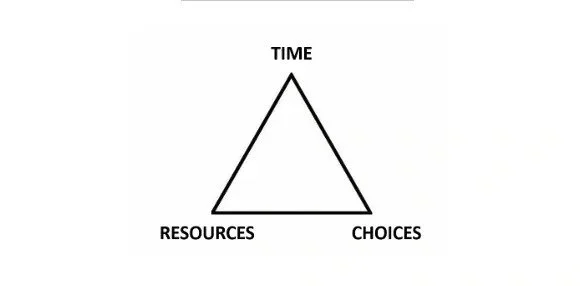
The 3 components shown in the diagram, in my opinion, encompass the majority of what we have control over in life. Unfortunately, it’s very little. While examining these three points, I’ve leaned into the fact that God is fully in charge, fully in control, and that it’s best that way. I’ve taught on this piece to hundreds of leaders in the past. Just this morning I covered it with a small team in one of our Foundation businesses. All of us could use a quick refresh on what God has placed in our hands, and examine how we’re utilizing the opportunity.
LET’S EXAMINE TRIANGLE OF CONTROL TOGETHER.
POINT #1 - TIME
If asked, many would say that time is a resource. Clearly, in this example, it is not. It’s displayed in a totally separate point on the triangle. Remember – this triangle is about what we consider to be in our “control”. Time itself is not in our control, but the allotted time that we are given is. In the equation of control, time is a constraint. It is a limiting factor, not something we can use. All things being equal, for every human on planet earth that makes it through each day, we are given the same identical constraint of 24 hours. 1,440 minutes. No more, no less. For every human being who makes it to age 80 – we are given the same number of weeks in life. Just 4,160. No more, no less.
This is not a resource that we can pay for, extract more of, or count on. It’s a limiting factor that we all experience throughout our lives, with an undetermined expiration date. Some of our greatest human fears exist because the limiting factor of time is so deeply sown within our hearts. We fear death because we have a clock ticking on our life. We fear the future because we don’t know how long it will last, or what it will bring. We crave meaning because we know that we don’t have forever to figure our life. Time is always on our minds, and always expiring, whether we like it or not.
POINT #2 - RESOURCES
We all have various degrees of resources at our disposal. Everyone from the richest man on earth to the poorest and most isolated have unique resources available. Let’s break down some practical examples that mostof us in America wake up with every single day.
1. Food. We can all typically get something to eat. Allows us to think longer term, rather than just finding our next meal for survival.
2. Shelter. Most of us can get into a shelter or already have permanent housing.
3. Cell phones. An overwhelming percentage of us now have simple means of instant communication via call and text.
4. The Internet. More so than ever we have information and purchasing power at our fingertips.
5. Education. Whether publicly available schools or the library, we have access to information and instruction like never before.
6. Electricity. We have the ability to see well into the night, which allows us to get far more done than previous generations before us.
7. Transportation. Cars, buses, trains, planes, boats, scooters, uber – we now have so many ways to get around even if we don’t own a vehicle. Many options are getting cheaper and more accessible even to less affluent populations.
8. Work. In today’s modern economy there are more ways to make income than ever before. Traditional jobs are still the norm, but a growing number of ways are emerging to be your own boss. Income diversity and income optionality has grown, providing resources and access to money in ways never seen in world history.
The resources at our disposal may be different, but they are plentiful and available in modern society in ways sometimes not known to historical Kings and Queens. Egyptian Pharaohs never knew the luxury of air-conditioning or turning on a light bulb. Even the richest of ancient rulers had to endure weeks of hard travel to see parts of their kingdom. Today, we can literally fly to the other side of the world in less than 24 hours. Time may be our constraint, but our resources are abundant. We are living through a time where the imagination is sometimes our greatest limitation.
POINT #3 - CHOICES
Well, here we are. With a time constraint and today’s available resources. What often separates the good from the great, or those we admire from those we forget, are the choices that we make with what we have available. Our choices mean everything. Now, this piece of the triangle is the most complex. Our choices are a reflection of our perceptions on how we judge incoming information, the belief structure that we rinse those perceptions through, and our ability to sift through potential rewards and consequences of our actions pertaining to those beliefs. Some choices are habits that are well formed and given little thought, and some choices are made based on current information. Our choices are what actually defines us. No one has ever been remembered for what they received – only for what they gave or did with what they had available. This prong of the triangle is the difference maker for all of us, whether a company or individual.
Today our reminder is that time is limited. Our resources are God given. Our freewill dictates how we’ll use what we’ve got with the time that we’ve got left. Up to us, but God is calling. He has plans and wants more for you than you could ever imagine. Today I’m doing some praying over which piece of the puzzle he’d like me to examine more closely, so I can get closer to him. Praying for you that you’ll all think on this and do the same!
-Mark
The Tithe - A Guard for Our Heart?
“Above all else, guard your heart, for everything you do flows from it.” — Proverbs 4:23
This verse isn’t casual. It’s not a suggestion to “check in” with your heart once in a while. It’s a clear, urgent instruction: “Above all else.” That means this is priority number one.
Protection for My Heart
“Above all else, guard your heart, for everything you do flows from it.” — Proverbs 4:23
This verse isn’t casual. It’s not a suggestion to “check in” with your heart once in a while. It’s a clear, urgent instruction: “Above all else.” That means this is priority number one.
Why? Because everything in your life—every word, every decision, every action—flows from the condition of your heart. And that’s why God cares so much about it. It’s the command center of our soul. Jesus knew this, which is why He tied our hearts so directly to our treasure.
Let’s start by looking at how God designed the physical heart. Here’s a summary from Harvard Medical School:
“The heart beats about 2.5 billion times in a lifetime, pushing millions of gallons of blood to every part of the body. This flow carries oxygen, fuel, hormones, and essential cells, while also removing waste. When the heart stops, vital functions fail—some almost immediately.”
Let’s break that down. Here’s what we learn from the physical heart:
It delivers life-giving nutrients to every part of the body.
If it fails, the body shuts down—instantly in many cases.
Poor habits (diet, inactivity, smoking) can damage it.
Buildup of harmful “gunk” (plaque) can clog the flow.
Healthy habits practiced early help prevent future issues.
Even if we’ve gone down the wrong path, course correction is possible.
Now let’s consider this: If the condition of our physical heart is that critical, what about our spiritual heart? The principles are the same. And if left unguarded, both can be damaged—by poor inputs, by neglect, by compromise.
The Spiritual Heart Mirror
Jesus' teaching on treasure and Solomon’s instruction in Proverbs both emphasize that your spiritual heart is the source of life. If it’s clogged—by greed, distraction, bitterness, or misplaced trust—the flow of your spiritual life is disrupted.
And here’s the good news: just like with your physical heart, there are healthy habits that protect and restore your spiritual heart. I believe tithing is one of the most powerful of those habits.
How the Tithe Mirrors Healthy Heart Habits
1. It’s Spiritual Exercise
Think of the tithe like a workout plan. You don’t get in shape by exercising once a year. It’s consistent, intentional, and builds over time. When you tithe regularly—whether from a salary, wages, or business—you are practicing discipline that strengthens your heart toward God.
As your income grows, your giving grows. And just like building muscle, the impact compounds. It aligns your priorities, shapes your habits, and trains your heart to put God first.
2. It Brings You Close to the Body
Where your treasure is, your heart will be also—and so will your presence. When we tithe into our local church, we become more connected to that community. We begin to care more. We show up more. We serve more.
Over time, it becomes a natural rhythm: giving, worshipping, growing, living life with others who are also aligning their hearts with God’s. Your heart grows toward the Kingdom when your treasure flows toward it.
3. It Turns the Physical Into the Eternal
In John 6, Jesus tells us His flesh is real food and His blood real drink. This wasn’t about physical nourishment—it was about eternal sustenance.
Likewise, when we tithe, we take something physical—a paycheck—and turn it into something spiritual. It’s not just charity. It’s worship. It’s declaration. It’s acknowledgment that God is our provider. And when we give, He uses it to impact eternity.
4. It’s a Prescription for Spiritual Flow
When the physical heart has blockages, doctors prescribe medications, new diets, or even surgeries to restore flow. Spiritually, when we’re clogged—by worry, pride, self-reliance—the tithe acts like a prescription to restore our connection to the Source.
By returning a portion to God first, we re-establish a proper flow in our spiritual lives. The result? Clarity. Peace. Purpose. Alignment. We stop hoarding and start trusting. We stop striving and start resting in God’s provision.
Final Thoughts
God doesn’t need your money. He wants your heart. And He knows how tied those two things are.
If everything in life flows from the heart, then we should be eager to guard it. And few practices protect the heart better than the consistent, faithful, joyful act of tithing. It cleanses, realigns, restores, and refocuses us on the One who gives us life in the first place.
So, guard your heart. Not just with words, but with your worship. Let your giving be part of your spiritual fitness routine—a habit that keeps your heart pumping strong for the Kingdom of God.
-Mark
Clear.
Clarity is one of the things I’ve sought more than almost anything else in life. And I know I’m not alone. I know dozens of leaders right now who are searching for clarity—some navigating complex business circumstances, others running teams that seem to be pulling in different directions, and still others re-evaluating what they’re even trying to achieve in the first place.
Clarity is one of the things I’ve sought more than almost anything else in life. And I know I’m not alone. I know dozens of leaders right now who are searching for clarity—some navigating complex business circumstances, others running teams that seem to be pulling in different directions, and still others re-evaluating what they’re even trying to achieve in the first place.
That’s normal, by the way.
Many ventures begin with a sense of competency in a particular field or a passion for a specific cause. Once things are in motion, the learning begins—and often, so does the questioning. Re-evaluating what you're trying to impact is not a sign of failure; it's a sign of growth. It’s healthy.
I’ve gotten this wrong in the past. But because of those mistakes, a few of the things I’m involved in today have become much clearer. Tithe Foundation is one of them.
What I love about the mission we’re on through Tithe Foundation is that it’s simple and clear:
"Honor God with our work, love our neighbor with proceeds, and help others do the same."
Missions that last typically revolve around just a few meaningful components. When those components are aligned, clarity becomes the foundation. Here are five key questions I’ve found essential to creating and sustaining clarity in any mission:
WHO?
Who should be on the mission? Just as importantly, who is the mission for?
WHY?
Why is the mission important enough to pursue? This answer can’t be manufactured—it has to come from something real.
WHERE?
Where is the impact focused? Are we going broad, or are we aiming to influence a specific place or group?
WHAT?
What actions will we take to fulfill the mission? Ideas must translate into action over time.
HOW?
What systems, rhythms, and accountability structures will we use to ensure we’re progressing and staying on course?
These questions may seem simple, but they’re not easy. If the answers are too vague or shallow, the cracks will show over time.
Let me walk you through how we’ve addressed each of these within Tithe Foundation:
OUR WHO
The mission is for Christ—to advance His Kingdom through our work.
Christian business leaders are on this mission with us, and more are welcome to join. There is room for all.
We carry this out by fueling local nonprofits so they have what they need to make an impact in their cause areas.
OUR WHY
Jesus says in Matthew 22:
“Love the Lord your God with all your heart and with all your soul and with all your mind.
This is the first and greatest commandment.
And the second is like it: ‘Love your neighbor as yourself.’
All the Law and the Prophets hang on these two commandments.
Our mission is a direct response to this call.
We exist to honor God with all that we do and love those in need around us.
We believe this glorifies the gifts God has given us and the time He’s blessed us with on earth.
OUR WHERE
We work in our local markets.
We chose to stay local because we want to be the hands and feet of Jesus and witness the direct impact of our mission.
Our business partners know that our aim is to serve and uplift the very communities where we live and work.
OUR WHAT
We tithe.
Each business in our network has dedicated their work to God and committed to return the first 10% (or more) of company profits to Kingdom causes.
Many also give their time, encouraging employees to serve within select nonprofit uorganizations.
Money and time—poured out to meet real needs. Tracked, compiled, and distributed at agreed upon intervals.
OUR HOW
We give throughout the year and gather quarterly to vote on grant distributions.
Here’s how it works:
Nonprofit partners apply for grants.
Our internal team vets applications and nonprofit needs.
The most impactful opportunities are presented to our business partners on a quarterly basis and in a specific and repeatable format.
After fully understanding the needs, partners vote on grant awards.
Distributions go out the very next day.
Impact is tracked and stories—both successes and struggles—are shared at each meeting.
Annually, we produce a full impact report for all partners to review and celebrate the year’s progress, while preparing for what’s ahead.
We don’t claim to be perfect.
But we aim to be clear.
If you’re a leader wrestling with uncertainty, I hope this framework helps.
If any of the five questions above haven’t been answered for your mission, start there!
One thing's for sure - your team needs clarity.
It may not be easy to define, but they crave it—and when you can help them understand the WHO, WHY, WHERE, WHAT, and HOW of your work, the momentum will follow.
-Mark
2 Stories, 2 Opportunities
This past weekend I was hit with some perspective—a powerful reminder of why we must stay alert for Kingdom opportunities wherever we are. I want to share two stories: one personal, the other through the eyes of my team. Together, they paint a picture of how God continues to move through the everyday lives of His people.
Kingdom Opportunities
This past weekend I was hit with some perspective—a powerful reminder of why we must stay alert for Kingdom opportunities wherever we are. I want to share two stories: one personal, the other through the eyes of my team. Together, they paint a picture of how God continues to move through the everyday lives of His people.
As we pursue business, family, and personal obligations, it’s easy to forget that Jesus is actively at work all around us. But we—His church—are called to be His hands and feet. While He can move wherever and however He wants, He most often chooses to move through us. He works through the willing.
Friday Night in Indianapolis
I was in Indianapolis for a golf event, staying in an Airbnb downtown. While my family, friends, and I were enjoying a fun evening inside, someone outside was experiencing one of the worst moments of their life.
My brother and I heard a car horn repeatedly honking in an unusual way. We looked out the window and saw a lone vehicle with the lights on in a nearby lot. We decided to step outside and check it out. What we found was heartbreaking.
A young woman named Lilly was in the car, going through a severe mental and emotional crisis. We called for emergency help, but while waiting, we began speaking with her through the window. Little by little, she opened up. We assured her that she was not alone, that God saw her, and that He loved her deeply, even in this darkest of moments. We were able to pray with her, comfort her, and help her to see that God had sent us there for her. It was no mistake.
She made it through the night. But the memory has stayed with me because it was such a clear example of a Kingdom opportunity. One we could have missed had we ignored the moment.
Saturday: Beds for Kids
On Saturday, some of our team members delivered beds to children in need around our city. Just 15 minutes from where most of us live, they encountered families living in some rough conditions. Children were sleeping on floors or in very inadequate arrangements. It was sobering to see, which wasn't new for this team.
But it was also motivating.
Our team’s love for the people they served was evident. I heard the stories when they returned, and while my heart often breaks for the realities others face, it also leaps with hope when I witness the compassion and generosity of those I get to work with. God is clearly on the move—through people who are willing to serve in whatever ways they can.
The Scriptures I Can’t Shake
There are two verses I haven’t been able to shake this week:
“Truly I tell you, whatever you did for one of the least of these brothers and sisters of mine, you did for me.”
— Matthew 25:40
“Which of these three do you think was a neighbor to the man who fell into the hands of robbers?”
The expert in the law replied, “The one who had mercy on him.”
Jesus told him, “Go and do likewise.”
— Luke 10:36–37
I can’t shake these verses for two reasons:
First, Jesus has already done everything for us. His invitation in Matthew 25, that when we care for others, it’s counted as if we’ve done it for Him is stunning. He knows each of us so well and loves us so deeply that when we show love to others, He receives it as love for Himself. That’s a beautiful truth.
Second, Jesus gives us a command in the parable of the Good Samaritan: “Go and do likewise.” That means when we see need, when we're wronged, when someone around us needs mercy, we must react. Being a neighbor, being a follower of Christ, means loving the people Jesus loves. And who does He love? Everyone.
The Opportunity Ahead
Sometimes Kingdom opportunities won’t be convenient. Sometimes they’ll disrupt your schedule or stretch your comfort zone. But the Holy Spirit is undefeated in introducing the right moment for His people to act.
Let’s keep our eyes open this week. Let’s live with purpose and compassion, remembering that God is on the move—and He wants to move through us!
-Mark
The Clock Is Winding Down
I had breakfast this morning with a friend who always leaves me feeling both challenged and encouraged. I know he left feeling the same. We do that for each other. There’s something powerful about friendships like that, ones that sharpen and stir you toward something greater.
I had breakfast this morning with a friend who always leaves me feeling both challenged and encouraged. I know he left feeling the same. We do that for each other. There’s something powerful about friendships like that, ones that sharpen and stir you toward something greater.
One part of our conversation struck us both in a deep and uncomfortable way. We talked about the tension between our desire to do meaningful work for the eternal Kingdom of God and the reality of living in a world full of distractions, distortions, and detours. Sometimes those distractions don't just slow us down, they stop us altogether. They keep us from starting the very things God may be calling us to do.
We let ideas and callings lie dormant, waiting for a “someday” that may never come.
That thought stuck with me all day.
Earlier this week, another friend passed along a sermon from Pastor Philip Anthony Mitchell of 2819 Church. It was about the signs of the times and being ready. Like really ready. Whether Christ returns in our lifetime or we meet Him when ours is over, the call is the same: Be found faithful.
One specific part of Jesus’ words in Matthew 24 hit me like a freight train:
Matthew 24:6–8
“You will hear of wars and rumors of wars, but see to it that you are not alarmed. Such things must happen, but the end is still to come. Nation will rise against nation, and kingdom against kingdom. There will be famines and earthquakes in various places.
All these are the beginning of birth pains.”
Birth pains. That phrase—Matthew 24:8—landed differently this time.
I’ve read that verse before, and I always assumed “birth pains” meant we still had a long way to go. But that’s not how birth pains actually work. Birth pains don’t start at conception. They don't come in the 1st, 2nd, or even most of the 3rd trimester. They come very near to the end, and as the moment of delivery draws closer, they intensify. They become more frequent and more severe.
That realization opened my eyes.
We are living in the time of contractions. The pressure is mounting. The urgency is growing. The clock is winding down.
Whether Christ returns soon or we meet Him at the end of our personal race, the time to act is now. This is not the season for passive faith. It’s not time to coast, check out, or hope someone else takes responsibility for making Jesus known.
We are the Church.
We are His hands and feet.
And we’ve been given our time, talents, treasure—and even our reputations—to steward for His glory.
That was the conversation at breakfast this morning. It wasn’t just casual encouragement; it was a call to wake up, press in, and step out. Use your gifts. Pick up the cross assigned to you. The Holy Spirit is present and ready to move through anyone who walks in step with Him.
It won’t be easy. But it will be worth it.
So here’s my challenge to you, as it was to me:
Don’t wait.
Not another week, not another year, not for a perfect moment that may never come.
The clock is winding down. Time to take the shots.
-Mark
The Main Thing
It sounds kind of obvious, but having a focus on the main thing is essential. There are so many distractions available to us throughout our time here on earth. I’d be willing to bet that most people, if given a few quiet minutes, could write down the top 3–5 things that matter most to them in life.
It sounds kind of obvious, but having a focus on the main thing is essential. There are so many distractions available to us throughout our time here on earth. I’d be willing to bet that most people, if given a few quiet minutes, could write down the top 3–5 things that matter most to them in life.
Now here’s the challenge: if we tracked and recorded our daily activity for 24 hours, I’d also bet that many of us would hesitate to present that day’s footage as proof that those priorities were actually lived out. I say that from personal experience. I used to be great at writing down what was most important to me, and then spending my time on something else entirely. The urgent, the loud, or the convenient would pull me away from what I truly cared about.
So—what is the main thing?
For followers of Jesus Christ, we don’t have to guess. Let’s look at Mark 12:28–31:
28 One of the teachers of the law came and heard them debating. Noticing that Jesus had given them a good answer, he asked him, “Of all the commandments, which is the most important?”
29 “The most important one,” answered Jesus, “is this: ‘Hear, O Israel: The Lord our God, the Lord is one.
30 Love the Lord your God with all your heart and with all your soul and with all your mind and with all your strength.’
31 The second is this: ‘Love your neighbor as yourself.’ There is no commandment greater than these.”
Love the Lord your God—with all your heart, soul, mind, and strength. The Main Thing.
Wow. That’s a tall order. And it begs the question: how much of my day is spent intentionally directing my heart, soul, mind, and strength toward loving God?
The truth is, God is always loving me. I exist by his pleasure, created in his image, and for the purpose of glorifying him. But—he allows me to choose how often I become aware of his presence. How often I seek his Kingdom. How often I speak with him. How often I act on his behalf, to do his will.
These are my choices. They matter. To God, and to those around me.
We would all do well to make our main thing obvious by how we spend our time. We may not be recorded 24/7 (at least, not yet), so it’s easy to live distracted. But one day, we will give an account.
And on that day, it will be clear: our hearts, minds, souls, and strength were never better spent than when they were focused on Jesus.
Just a gentle reminder—to myself, and to all of us:
Let’s stay focused on the main thing.
-Mark
An Army Is Rising!
Week after week, I feel this happening. I see it with my own eyes. If I didn’t see it, I might not believe it. But I’m here to tell you that it’s the truth.
Week after week, I feel this happening. I see it with my own eyes. If I didn’t see it, I might not believe it. But I’m here to tell you that it’s the truth.
An army is rising—like one I’ve never seen before. It’s the leaders and the doers in business. Their yearning for more is beginning to take shape. Rather than work simply for the here and now, they want something more significant. They want real influence that lasts. And they’re finding it. Honoring God with their work and making a lasting impact beyond the dollars and cents of their product or service is their aim.
Today, I met with four business guys—all back to back. Their expertise ranges from financial planning to real estate development, all the way to SaaS sales. The common thread? A love for Jesus, and a desire to use their influence and network to grow God’s Kingdom and make Him even more known.
God isn’t new at assembling armies. At times, He does it through humanity. Other times, He does the heavy lifting on His own. I’m reminded of an army that was assembled from the least expected of places in Ezekiel—from the dead and dry bones laid before him. Let’s read from Ezekiel Chapter 37:
3 He asked me, “Son of man, can these bones live?”
I said, “Sovereign Lord, you alone know.”
4 Then he said to me, “Prophesy to these bones and say to them, ‘Dry bones, hear the word of the Lord!’
‘This is what the Sovereign Lord says: Come, breath, from the four winds and breathe into these slain, that they may live.’”
10 So I prophesied as he commanded me, and breath entered them; they came to life and stood up on their feet—a vast army.
The army of business and marketplace believers is being assembled. Our work matters quite a bit to God. He’s not as much worried about our success for earthly gain, but He does want us to be wildly successful—all with a motive to honor Him with our gifts, and to use what we obtain to make some noise and shake things up for His Kingdom. To let the light of Christ shine through us. At work, at home, in leisure, and in rest.
The silent army may have been considered dead. The marketplace may have been thought of as taken over by the secular. But a breath of life has been spoken over a multitude, and I believe it’s just getting started. Our work will indeed become sacred again.
For those already living this way—we’re about to be joined! We’ll need you to help mentor the next generation hungry for more.
The army is assembling—time to have some fun!
For any interested in talking more or learning how to process what's next - message me directly!
-Mark
Break Pedals
Every now and then, taking your foot off the gas can be a very good thing.
I’m not talking about quitting your mission or giving something half-effort. I’m talking about hitting the brake pedal, intentionally, for the purpose of rest and recharge.
Every now and then, taking your foot off the gas can be a very good thing.
I’m not talking about quitting your mission or giving something half-effort. I’m talking about hitting the brake pedal, intentionally, for the purpose of rest and recharge.
Last week, I had the opportunity to do just that with my family on a much-needed vacation. And let me tell you: nothing reveals where you really stand in your work, relationships, and personal well-being quite like slowing down.
Jesus did this, and I believe for very good reason.
Jesus Took Breaks on Purpose
Scripture shows us again and again that Jesus withdrew to isolated places (Luke 5:15–16). In Mark 6:30–32, after His disciples returned from ministry, He told them:
“Come with me by yourselves to a quiet place and get some rest.” (Mark 6:31)
They got in a boat and went away, even though crowds were still pursuing them. Needs were great—but so was the need for sustainable rhythms.
Jesus didn’t model endless output. He modeled restful obedience and wisdom.
Even the Savior of the world paused.
What I Learned on the Brakes
This past week, I learned a few things in the slowdown:
I realized how many things pull at my attention that really aren’t that important.
I remembered what I love most about my daily pursuits in work, family, and ministry.
I thought of people I hadn’t connected with in a while who matter deeply.
Most of all, I invested fully in the ones who will one day sit in the front row at my funeral—my wife and my sons.
Break time and the brake pedal are powerful tools in the life of someone who wants to live and lead with intention.
Back in Action
I’m thankful to be back—and recharged.
Purposeful rest leads to purposeful next steps.
As the summer rolls on, I hope you get a day or two to tap the brakes. Not to drift off-course, but to regain your bearings and come back with clarity, joy, and energy.
Let’s not just run hard—let’s also rest well.
-Mark
Expertise vs. Experience
Today, more than 120 men gathered to glean wisdom from over a century of combined fatherly and grandfatherly experience. Kingdom Dads hosted a powerful event for fathers and sons, centered around one simple but profound goal: learn from those who’ve walked the road ahead of us.
Old Guys Know.
Today, more than 120 men gathered to glean wisdom from over a century of combined fatherly and grandfatherly experience. Kingdom Dads hosted a powerful event for fathers and sons, centered around one simple but profound goal: learn from those who’ve walked the road ahead of us.
Three “sages”—seasoned leaders of businesses, ministries, churches, and, most importantly, families, shared from the well of their lives. What stood out most wasn’t their expertise, but their experience.
So often, when we attend panels or conferences, the draw is someone's niche expertise. And that’s valuable. Tactical insights matter. But when it comes to fatherhood, there isn’t a formula. No manual can tell you how to handle the curveballs that come with raising a family. There's no perfect calendar to balance work and family, no app to pre-program intentional moments of love, correction, or legacy.
Because God didn’t make robots. He made people. And each one of us is different. Different kids. Different parents. Different stories.
That’s why experience matters so deeply.
Being a dad is about leadership. And leadership is best learned not just from theory, but from those who have lived it well.
Here were the three biggest takeaways from today’s panel:
1. “You will never have more energy than you have today.” – Sam Koon
The point? Invest now. Take the time now. Have the conversations that matter, while you still can. Be playful, be present, be all-in.
As life progresses, our children’s energy drifts toward their own pursuits—and ours naturally fades. Sam reminded us: don’t wait to engage. Today is the most powerful day you have.
2. “Family Together Nights.” – Doug Franck
Doug shared a brilliant tradition—nights set aside with one goal: be together.
No distractions. Just games, cooking, dinner, and conversation. One idea especially stood out: he’d sneak hand-written questions under each kid’s dinner plate. During dinner, they’d reveal and answer them as a family.
Simple. Intentional. Unforgettable.
The goal isn’t perfection. It’s connection.
3. “You cannot lead farther than you’ve gone.” – Tyler Flynn
Tyler, a pastor of nearly 30 years, has preached thousands of sermons. But what mattered most wasn’t his ministry—it was that his family never took second place.
He shared a recent story of walking through a health crisis with his wife. A brush with death that tested everything. Through it, their children and grandchildren witnessed living faith. Unshakable trust.
Tyler’s challenge was simple but strong: keep pursuing Jesus daily. Your spiritual growth isn’t just for you—it becomes a path others can follow.
Experience vs. Expertise
Both matter. Sometimes we need laser-focused advice to solve a specific problem. Other times, we need a wide-lens perspective to navigate something as sacred and nuanced as raising a child.
Today, we were blessed by experience.
And I believe every man in that room left changed. Sharpened. Strengthened. Inspired.
Not just to become better fathers—but to become better Kingdom Dads.
-Mark