

Assume Nothing
Too many times we see things from the outside and immediately make assumptions. We do this most often with people.
Everyone has heard the phrase “Don’t judge a book by its cover.” But we do.
Too many times we see things from the outside and immediately make assumptions. We do this most often with people.
Everyone has heard the phrase “Don’t judge a book by its cover.” But we do.
I just released a book, and my publisher spent time thinking through what he believed would make a great cover. Why? Because people pay attention to covers. We buy bottles of wine based on logos and bottle shapes. Some of us purchase cars we know are prone to breakdowns simply because they look cool. The makeup industry exists to enhance appearance.
We make a lot of assumptions based on first impressions—on what we see on the outside.
But lately I’ve been reminded that things are not always what they seem. We’re all very good at hiding what’s insecure. We’re great at faking what doesn’t come naturally. Sometimes we feel that needing others for their strengths only highlights our weaknesses.
These aren’t assumptions I’m making—they come from real conversations with real people.
The truth? We’re all weak. Strong in certain areas of life, sure, but weak overall. Fragile. Mortal. In constant need of strength—and ultimately, in need of a Savior before our time is up. That’s a fact.
As Christians, we don’t have to put on false covers for one another. Our weaknesses are okay. In fact, they’re how we truly learn to rely on Jesus. Check this out:
“My grace is sufficient for you, for my power is made perfect in weakness.” Therefore I will boast all the more gladly about my weaknesses, so that Christ’s power may rest on me. That is why, for Christ’s sake, I delight in weaknesses, in insults, in hardships, in persecutions, in difficulties. For when I am weak, then I am strong.”
— 2 Corinthians 12:9–10
Here Paul reminds us that true strength doesn’t come from presenting ourselves as something we’re not, but from relying on the One who supplies it—the One who has conquered death and overcome what overtakes so many of us in this life.
We see this again in Philippians 4:11–13:
“I am not saying this because I am in need, for I have learned to be content whatever the circumstances. I know what it is to be in need, and I know what it is to have plenty. I have learned the secret of being content in any and every situation, whether well fed or hungry, whether living in plenty or in want. I can do all this through him who gives me strength.”
What can Paul do through Christ who gives him strength? He can be content.
His outer circumstances don’t sway him one way or the other. When in need—God is his aim and his strength. In times of plenty—he gives thanks to God. There’s no false sense of self and no need to mask what’s true. His contentment lies entirely in the free gift of grace.
So this message is to my fellow believers:
We don’t want to become walking puddles of weakness—that’s not what living a full life for Christ looks like. But we must guard ourselves from living as the world does: drawing from our own strength, only to mask what’s really there. Making an impression with our cover, while quietly knowing what lies beneath.
Find a peer, a mentor, a spiritual brother or sister who can see behind the cover—someone who doesn’t have to assume. Strengthen each other by turning to the Lord with your troubles, your questions, and your praises.
Let’s be great examples of true strength—not by what we present, but by Who we draw from. Let’s drink deeply from the well of living water, and eat from the bread of life.
Be a beacon of strength today—by embracing who you are, and who He is.
-Mark
Fully Awake
This week has been fantastic. A rich mix of meetings — work, partnerships, nonprofit activity, and plenty of family time as we plan for the upcoming school year. Each conversation was different and unique, but all were full of opportunities to be fully awake and fully alive.
This week has been fantastic. A rich mix of meetings — work, partnerships, nonprofit activity, and plenty of family time as we plan for the upcoming school year. Each conversation was different and unique, but all were full of opportunities to be fully awake and fully alive.
Today in my Bible reading, I came across the verse that inspired this title:
“Peter and his companions were very sleepy, but when they became fully awake, they saw his glory…” — Luke 9:32
The context here is the transfiguration of Jesus. His face changed, and His clothes became as bright as a flash of lightning. That’s what it took for Peter, James, and John to truly wake up. Honestly, I think that’s probably about what it would take for me too.
To be fully awake and fully alive in Jesus Christ would be the ultimate way to live. But so far, I haven’t met anyone who’s completely living that way — and based on Luke 9, it seems the twelve disciples didn’t have it mastered either. Still, we see throughout the New Testament that they did have moments — moments when they were on fire, alert, and laser-focused on spreading the Gospel.
This week, I’ve seen glimpses of this kind of living all around me:
Businessmen, parents, teachers, and friends taking bold steps to use their God-given gifts for the Lord.
Prayer in the workplace, Bible studies starting in offices, and generosity flowing from business profits.
Teachers and parents committed to raising children with a biblical worldview as the school year begins.
Mortgage professionals and realtors partnering to help a family achieve homeownership, then donating from that closing to help neighbors in need.
Fully awake. Even for just a moment.
Jesus is present in every moment with us. Always by our side. Sometimes our eyes are heavy and our hearts distracted. Other times, we are aware — really aware — of His presence. In those moments, our steps look different, our hearts are open to His call, and our actions reflect His heart.
My prayer as we end this Friday is that our eyes and hearts would awaken to what God has for us this weekend — that we would walk in step with Jesus along the way.
-Mark
3 Points: The Triangle of Control
Just this morning I covered it with a small team in one of our Foundation businesses. All of us could use a quick refresh on what God has placed in our hands, and examine how we’re utilizing the opportunity.
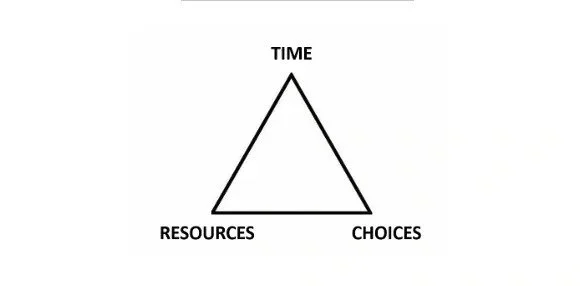
The 3 components shown in the diagram, in my opinion, encompass the majority of what we have control over in life. Unfortunately, it’s very little. While examining these three points, I’ve leaned into the fact that God is fully in charge, fully in control, and that it’s best that way. I’ve taught on this piece to hundreds of leaders in the past. Just this morning I covered it with a small team in one of our Foundation businesses. All of us could use a quick refresh on what God has placed in our hands, and examine how we’re utilizing the opportunity.
LET’S EXAMINE TRIANGLE OF CONTROL TOGETHER.
POINT #1 - TIME
If asked, many would say that time is a resource. Clearly, in this example, it is not. It’s displayed in a totally separate point on the triangle. Remember – this triangle is about what we consider to be in our “control”. Time itself is not in our control, but the allotted time that we are given is. In the equation of control, time is a constraint. It is a limiting factor, not something we can use. All things being equal, for every human on planet earth that makes it through each day, we are given the same identical constraint of 24 hours. 1,440 minutes. No more, no less. For every human being who makes it to age 80 – we are given the same number of weeks in life. Just 4,160. No more, no less.
This is not a resource that we can pay for, extract more of, or count on. It’s a limiting factor that we all experience throughout our lives, with an undetermined expiration date. Some of our greatest human fears exist because the limiting factor of time is so deeply sown within our hearts. We fear death because we have a clock ticking on our life. We fear the future because we don’t know how long it will last, or what it will bring. We crave meaning because we know that we don’t have forever to figure our life. Time is always on our minds, and always expiring, whether we like it or not.
POINT #2 - RESOURCES
We all have various degrees of resources at our disposal. Everyone from the richest man on earth to the poorest and most isolated have unique resources available. Let’s break down some practical examples that mostof us in America wake up with every single day.
1. Food. We can all typically get something to eat. Allows us to think longer term, rather than just finding our next meal for survival.
2. Shelter. Most of us can get into a shelter or already have permanent housing.
3. Cell phones. An overwhelming percentage of us now have simple means of instant communication via call and text.
4. The Internet. More so than ever we have information and purchasing power at our fingertips.
5. Education. Whether publicly available schools or the library, we have access to information and instruction like never before.
6. Electricity. We have the ability to see well into the night, which allows us to get far more done than previous generations before us.
7. Transportation. Cars, buses, trains, planes, boats, scooters, uber – we now have so many ways to get around even if we don’t own a vehicle. Many options are getting cheaper and more accessible even to less affluent populations.
8. Work. In today’s modern economy there are more ways to make income than ever before. Traditional jobs are still the norm, but a growing number of ways are emerging to be your own boss. Income diversity and income optionality has grown, providing resources and access to money in ways never seen in world history.
The resources at our disposal may be different, but they are plentiful and available in modern society in ways sometimes not known to historical Kings and Queens. Egyptian Pharaohs never knew the luxury of air-conditioning or turning on a light bulb. Even the richest of ancient rulers had to endure weeks of hard travel to see parts of their kingdom. Today, we can literally fly to the other side of the world in less than 24 hours. Time may be our constraint, but our resources are abundant. We are living through a time where the imagination is sometimes our greatest limitation.
POINT #3 - CHOICES
Well, here we are. With a time constraint and today’s available resources. What often separates the good from the great, or those we admire from those we forget, are the choices that we make with what we have available. Our choices mean everything. Now, this piece of the triangle is the most complex. Our choices are a reflection of our perceptions on how we judge incoming information, the belief structure that we rinse those perceptions through, and our ability to sift through potential rewards and consequences of our actions pertaining to those beliefs. Some choices are habits that are well formed and given little thought, and some choices are made based on current information. Our choices are what actually defines us. No one has ever been remembered for what they received – only for what they gave or did with what they had available. This prong of the triangle is the difference maker for all of us, whether a company or individual.
Today our reminder is that time is limited. Our resources are God given. Our freewill dictates how we’ll use what we’ve got with the time that we’ve got left. Up to us, but God is calling. He has plans and wants more for you than you could ever imagine. Today I’m doing some praying over which piece of the puzzle he’d like me to examine more closely, so I can get closer to him. Praying for you that you’ll all think on this and do the same!
-Mark
Just Persevere.
Many times in leadership or in roles where creation or business is the focus, difficult seasons have a way of lingering longer than we’d like. So, we innovate. We make the necessary changes. We do our best to stay positive.
But we’re human. And eventually, the extra effort starts to wear us down.
Many times in leadership or in roles where creation or business is the focus, difficult seasons have a way of lingering longer than we’d like. So, we innovate. We make the necessary changes. We do our best to stay positive.
But we’re human. And eventually, the extra effort starts to wear us down.
Lately, I’m hearing this story from many business owners and leaders. It’s been a tough stretch across many industries over the past several years. Some leaders have risen to the occasion. Others have walked away in search of a simpler path forward.
Both of those responses are normal. They’ve repeated themselves throughout history. As the wise Solomon once said, "There is nothing new under the sun."
But if you’re reading this and you're feeling the strain, yet deep down you know you’re called to this path, my best advice is this:
Just persevere.
Let’s define that for a moment:
per·se·vere: to persist in a state, enterprise, or undertaking in spite of counterinfluences, opposition, or discouragement. To continue in a course of action even in the face of difficulty.
For those of us who started something, chose to be part of something, or felt called to a particular field, difficulty was part of the deal. It was never a reason to quit.
Most of us began this journey knowing it wouldn’t be easy… but we believed it would be worth it. Any mission worth pursuing will require risk. It will demand hard work. That’s why we keep showing up, even when it feels like no one sees, no one cares, or when we ourselves wonder if it will make a difference.
Still—we press on.
The Bible has something to say about moments like these:
James 1:12
“Blessed is the one who perseveres under trial because, having stood the test, that person will receive the crown of life that the Lord has promised to those who love him.”
Leaders often face trials. James connects perseverance with eternal reward—encouraging us to stay faithful under pressure.
Galatians 6:9
“Let us not grow weary of doing good, for in due season we will reap, if we do not give up.”
A powerful call to persistent leadership—especially when fruit isn’t immediately visible.
Romans 5:3–4
“We also glory in our sufferings, because we know that suffering produces perseverance; perseverance, character; and character, hope.”
These seasons are not wasted. They shape your character and deepen your hope—critical for leaders becoming more like Christ.
So if this is you today, count the pressure you’re under as formation. Your character is being refined. And yes, you do have hope.
If the mission you’re on was a chosen one, remember what you love about it. When your heart first decided on it, something stirred in you. Don’t forget that. Revisit your calling. Reclaim your joy, even in the difficulty.
Stand the test of time.
When the season of reaping comes, you’ll look back on these trials with gratitude. They’ll become the stories you tell, and some of your proudest memories. So examine your mission again. And if it still passes the test of your heart…
Just persevere.
-Mark
When to Roll Up Your Sleeves
There are a ton of articles out there on delegation and why great leaders become masters at this art. I absolutely believe that our focus should be primarily on the things that only we can do, and that we should allow others to handle tasks they are capable of executing well. However, from time to time, even leaders need to step up and complete the task at hand—regardless of what that work looks like. There is something profoundly impactful about a leader who truly understands how to get the job done.
Rolling Up Your Sleeves vs. Delegation
There are a ton of articles out there on delegation and why great leaders become masters at this art. I absolutely believe that our focus should be primarily on the things that only we can do, and that we should allow others to handle tasks they are capable of executing well. However, from time to time, even leaders need to step up and complete the task at hand—regardless of what that work looks like. There is something profoundly impactful about a leader who truly understands how to get the job done.
Not just the big overarching "job," but also the small, daily tasks that those who report to us perform regularly. A lot of learning takes place when we get into the weeds, and this firsthand experience often enables us to make better decisions by getting up close and personal with the work.
The Bible has insightful wisdom on the balance between delegation and rolling up our sleeves. Let’s take a look.
Doing the Work Yourself
Proverbs 14:23 – "All hard work brings a profit, but mere talk leads only to poverty."
This emphasizes that personal effort and diligence lead to results.
Colossians 3:23 – "Whatever you do, work at it with all your heart, as working for the Lord, not for human masters."
A reminder that our work should be done with dedication and excellence, as if serving God.
Galatians 6:4-5 – "Each one should test their own actions. Then they can take pride in themselves alone, without comparing themselves to someone else, for each one should carry their own load."
Encourages personal responsibility for one's own work.
Delegating and Leadership
Exodus 18:17-23 – (Jethro’s advice to Moses) "What you are doing is not good. You and these people who come to you will only wear yourselves out... Select capable men from all the people and appoint them as officials over thousands, hundreds, fifties, and tens."
Moses was advised to delegate tasks so he wouldn’t be overwhelmed.
Acts 6:2-4 – "It would not be right for us to neglect the ministry of the word of God in order to wait on tables... We will turn this responsibility over to them and will give our attention to prayer and the ministry of the word."
The apostles delegated tasks so they could focus on their primary mission.
So what should we do?
These verses highlight an important balance. Proverbs 14:23 warns us against being all talk and no action—we need to understand the work itself when leading others. In Acts 6, the apostles chose wisely what to delegate and what to keep. They didn’t offload all work to simply take on managerial or QC roles. Instead, they kept the most vital tasks that required direct engagement with people's spiritual well-being, while delegating other necessary but different responsibilities.
While delegation is smart and often necessary, my encouragement to you today is to find a way to get close to those doing the real work. Roll up your sleeves. Give some of it a shot. Have some fun with it. Learn. Not only will you benefit, but those you lead will as well—because they will see a leader worth following!
-Mark
Freewill: We All Have to Make A Choice
This morning, I had the chance to talk with someone older and wiser than I prior to our morning Bible study. He's older, but boy, does he still have energy! He's one of those guys you aspire to be when you're in your 70s. God willing, I will be!
This morning, I had the chance to talk with someone older and wiser than I prior to our morning Bible study. He's older, but boy, does he still have energy! He's one of those guys you aspire to be when you're in your 70s. God willing, I will be!
We were discussing the difficulties of parenting kids who are entering interesting years—the years when they will be faced with decisions that parents aren't always around to shepherd them through. He told his sons early on that while they live under his roof, they play by his rules. But sooner or later, they’ll also be faced with a choice: What values will they hold dear? What principles will they live by? What corners will they cut—or not cut?
These decisions come for all of us, and regardless of our upbringings, we all must eventually choose for ourselves. This is the way that God designed it, and for a reason. Real love only comes from a free and willing heart, and He allows all of us the option to choose.
Here are some quick Bible verses on freewill:
Joshua 24:15 – "And if it is evil in your eyes to serve the Lord, choose this day whom you will serve, whether the gods your fathers served in the region beyond the River, or the gods of the Amorites in whose land you dwell. But as for me and my house, we will serve the Lord."
Proverbs 16:9 – "The heart of man plans his way, but the Lord establishes his steps."
We have the freedom to plan our lives, but God ultimately guides our path.
Galatians 5:13 – "For you were called to freedom, brothers. Only do not use your freedom as an opportunity for the flesh, but through love serve one another."
Paul reminds believers that free will should be used to serve others and honor God.
Revelation 3:20 – "Behold, I stand at the door and knock. If anyone hears my voice and opens the door, I will come in to him and eat with him, and he with me."
Jesus presents an invitation, but it is up to each person to choose to accept Him.
These verses show that while God has a plan, He allows us the freedom to choose Him or go our own way.
I thank God that He has surrounded me with others who have made their choices clear. Their values and principles play out daily and show the conviction they have to act boldly in their work, raising their families, and giving their time to causes they appreciate.
Just remember as you head into this weekend: Our choices are real, have consequences, and matter to God. He allows us to have them for a reason, and it isn't trivial. We should all search our hearts to ensure that the gift of freewill given to us is used to glorify the Giver.
As we enter next week, let’s go for it and give others a reason to choose God’s path as well!
-Mark
Momentum: Knowing When to Act!
Life has a funny way of timing things. Opportunities, challenges, and flurries of activity in both our personal and professional lives often seem to come all at once. And then, just as suddenly, we may find ourselves in seasons of waiting—times of preparation, reflection, and wondering what comes next.
Life has a funny way of timing things. Opportunities, challenges, and flurries of activity in both our personal and professional lives often seem to come all at once. And then, just as suddenly, we may find ourselves in seasons of waiting—times of preparation, reflection, and wondering what comes next.
I've learned that recognizing when to act and when to be still is a critical skill. When times of action arise, it’s essential to discern which opportunities to seize and which to let go. Scripture provides wisdom on how to navigate these moments. When God presents opportunities, we are called to respond.
Biblical Wisdom on Seizing the Moment
Proverbs 10:5 (NIV) – "He who gathers crops in summer is a prudent son, but he who sleeps during harvest is a disgraceful son."
→ This verse highlights the importance of taking action at the right time and not delaying when opportunities arise.
James 4:17 (NIV) – "If anyone, then, knows the good they ought to do and doesn’t do it, it is sin for them."
→ Hesitation can lead to missed divine opportunities; when God presents a moment, we must act in obedience and faith.
Galatians 6:9 (NIV) – "Let us not become weary in doing good, for at the proper time we will reap a harvest if we do not give up."
→ Diligence in doing good is key, as God’s timing will bring forth a harvest when we remain steadfast.
Colossians 4:5 (NIV) – "Be wise in the way you act toward outsiders; make the most of every opportunity."
→ This verse encourages us to recognize moments of influence and growth and to use them for God’s glory.
Momentum and Spiritual Readiness
Momentum builds upon itself. The phrase "on a roll" exists because movement generates more movement. Keeping things in motion is much easier than starting from a complete stop. God understands this and often provides seasons of opportunity where doors open, relationships flourish, and work becomes fruitful.
These seasons can be exhilarating, challenging, and even exhausting, but they are also some of the most productive and rewarding times when we embrace them with the right mindset. While God does not want us to burn out, He does desire that we work alongside Him with purpose and diligence.
When we are blessed with opportunities to glorify God through our work and actions, let us seek His wisdom in discerning the right steps to take. Let us remain prayerful, strategic, and faithful—trusting that He will guide our momentum in ways that align with His perfect plan.
Are you in a season of action or waiting? Either way, prepare your heart and mind, because when the time to act comes, God wants you ready!
-Mark
Perception: We Do Not See Things the Way They Are
I love the variety of conversations and viewpoints I get to hear each week. I’m consistently reminded of a quote that was drilled into my head for years while participating in Built To Lead training with Chet Scott:
“We do not see things the way they are, we see things the way we are.”
Ain’t that the truth.
How We See: The Way We Are
I love the variety of conversations and viewpoints I get to hear each week. I’m consistently reminded of a quote that was drilled into my head for years while participating in Built To Lead training with Chet Scott:
“We do not see things the way they are, we see things the way we are.”
Ain’t that the truth.
Today, I heard a speaker present an issue that he believes permeates our world—a gap or divide between leaders who work within the church and leaders in the business world who attend them. Many of the viewpoints he shared were, in my opinion, correct about the common differences in the ways we operate. Certain formalities in business do not always translate to formal ministry roles. However, some points were delivered as absolute truths that create obstacles, but I did not find them to be universally true in my experience. This is the highlight of today’s reflection: Our experiences shape us and often create the lens through which we view life.
Perception is a tricky thing. It not only helps us decide on our actions, but it also influences how we reflect and form judgments regarding our outcomes. We must learn to perceive wisely, or we risk believing that our individual experience and sight are the only correct perspectives.
Let’s take an example from Jesus that shows us that what we see is not always the entire picture.
The Feeding of the Five Thousand
The story of Jesus feeding the five thousand is one of the most powerful examples of how God’s perspective on provision differs from ours. It appears in all four Gospels, emphasizing its importance.
The Human Perspective: Scarcity and Limitations
Jesus and His disciples had been ministering to a massive crowd, and as the day wore on, the disciples became concerned. They saw:
A huge crowd of over five thousand men, plus women and children—possibly 15,000-20,000 people total.
Limited resources—only five loaves and two fish (John 6:9).
A remote location where food couldn’t be easily obtained (Matthew 14:15).
A logical solution—send the people away so they could buy their own food (Mark 6:36).
From a human standpoint, the problem was overwhelming. They saw lack rather than abundance, difficulty rather than opportunity.
Jesus’ Perspective: Abundance Through Faith
Instead of being overwhelmed, Jesus saw God’s provision rather than human limitation. His response teaches us several key lessons:
Bring What You Have to God (Even If It Seems Small)
The disciples focused on what they lacked, but Jesus asked them, “What do you have?” (Mark 6:38).
They brought five loaves and two fish—an insignificant meal for thousands.
Lesson: We often focus on our limitations, but God asks us to bring what we do have, no matter how small.
Trust in God's Provision, Not Human Reasoning
Jesus took the food, gave thanks, and broke it (John 6:11).
He didn’t focus on how little it was—He trusted the Father for multiplication.
Lesson: Instead of doubting, we should thank God in advance and trust that He will provide.
God Provides More Than Enough
As Jesus distributed the food, everyone ate and was satisfied (Matthew 14:20).
Not only was there enough—there were 12 baskets of leftovers!
Lesson: God’s provision is more than enough; He doesn’t just meet our needs, He exceeds them.
As leaders in either business or formal ministry, we need to remember that God's view is the lens through which we should aim to see. Our plans should align with His plans. Our vision should take us down the road He has prepared for us. The provision to carry out His plans will indeed come if we are consistently in step with His Spirit. Our unique gifts and strengths will be utilized when the time is right for our part to be played.
As we end the week and reflect, ask God to allow you to see things from His lens.
“We do not see things the way they are, we see things the way WE are.”
But God sees perfectly—let’s seek His vantage point as we continue to pursue the missions to which we’ve been called.
-Mark
Unexpected Detours: How To See the Next Step
Today, I had the privilege of serving some of the neediest in our city alongside two close friends I’ve known for nearly 15 years. Freely giving time to make others feel seen and known is one of the best feelings that money can't buy.
Seeing Through a New Lens: The Power of Serving Others
Today, I had the privilege of serving some of the neediest in our city alongside two close friends I’ve known for nearly 15 years. Freely giving time to make others feel seen and known is one of the best feelings that money can't buy.
One of these friends has been going through a difficult season in life—something we all experience at times. In this case, it’s business-related. When our businesses struggle or our personal pursuits take unexpected detours, it can feel as if the entire world is crashing down. Our minds become wrapped up in our thoughts, fears, and broken plans, making it easy to lose sight of the bigger picture.
We tend to view our situation in a "subjective absolute"—meaning we assume that things will always be the way they are now, that they will never change. That circumstances will continue to unfold against us. This false perception can trap us in a cycle of worry and despair.
The best way I’ve seen this mindset shift is by rolling up our sleeves and serving someone else. There is nothing more powerful than helping someone solve a problem, and when we can’t immediately solve our own, the momentum we create by assisting others can be transformative.
This reminds me of Jesus and the moment before He sent out the Twelve disciples in pairs. In Mark 6:7-13, Jesus gathered His disciples and sent them out with nothing but the essentials—no money, no extra food or clothing—so they would rely on God and the kindness of others. Their mission was not about themselves; it was about healing, teaching, and bringing hope to others.
But what came just before this? Jesus had just faced rejection in His hometown. Mark 6:1-6 tells us that when He returned to Nazareth to teach, the people doubted Him because they had known Him as a carpenter, the son of Mary. Their lack of faith prevented Him from performing many miracles, and He marveled at their unbelief before moving on.
Think about that—Jesus was rejected by those who knew Him best. Instead of dwelling on the hurt, He immediately turned His focus outward, sending His disciples to serve others. He didn’t allow rejection to derail His mission; He responded with action and purpose.
This is our example. If you find yourself in a difficult place, uncertain of your next move, take a step to help someone else. Reach out a hand. Serve. Encourage. Give. Clarity often follows when we shift our perspective, and nothing shifts our perspective more powerfully than stepping outside of ourselves and into the lives of others.
Jesus didn’t dwell on rejection—He got to work. And so should we.
-Mark
Grey Areas: They Can Test Your Heart
As Christians, we are given the gift of God’s Word to help us process our next steps. There are many things in the Bible are made perfectly clear to us. These rules aren’t given to us by God to make life tedious or difficult; rather, they provide the freedom to move inside and outside of the lines with clarity
How to Move When the Steps Aren’t Perfectly Clear
As Christians, we are given the gift of God’s Word to help us process our next steps. There are many things in the Bible are made perfectly clear to us. These rules aren’t given to us by God to make life tedious or difficult; rather, they provide the freedom to move inside and outside of the lines with clarity. But - what do we do when we find ourselves in a situation that is not explicitly addressed in Scripture? This is a challenge that I and many leaders have wrestled with. Let’s review a well-known example to learn from together.
Throughout His ministry, Jesus was often confronted with difficult questions. Instead of offering simple, black-and-white answers, He would appeal to our hearts. After all, our hearts are what God is ultimately after. One example of this is found in Mark 12, where the Pharisees attempt to trap Jesus with a question about paying taxes:
“Is it right to pay the imperial tax to Caesar or not? Should we pay or shouldn’t we?”
But Jesus knew their hypocrisy. “Why are you trying to trap me?” he asked. “Bring me a denarius and let me look at it.” They brought the coin, and he asked them, “Whose image is this? And whose inscription?”
“Caesar’s,” they replied.
Then Jesus said to them, “Give back to Caesar what is Caesar’s and to God what is God’s.” (Mark 12:14-17)
What an amazing perspective. However, a question that arises in our modern day may be this: What exactly belongs to Caesar, and what belongs to God? One common example among Christians is the principle of tithing. The Bible teaches that the first 10% of our income or produce is holy and consecrated to the Lord. Now here’s the modern predicament: should off of our gross income or our net income?
Jesus does not make this distinction. The answer is unclear.
If God has left out a detail, then perhaps the detail itself is not the issue He cares to specify. Instead, God desires our hearts. Only we know what is truly leading and mastering our hearts—though God knows too.
When we face these unclear situations that lack perfect guidance, we should reflect on God’s Word, learn from the examples of others, and, most importantly, search our hearts. Is our decision drawing us closer to the Lord? Are we becoming more of a light for others? If the answers to those questions are yes, just continue walking with God, trusting Him even when full clarity is out of reach.
-Mark